


How it works
Measure the top
Use the finished top, edge to edge, before it is basted to anything.
Choose the extra
Backing has to be bigger than the top. About 2 in per side suits home machine quilting; a longarm quilter usually asks for 4 in.
Pick the fabric width
Standard cotton is 42 to 44 in on the bolt but loses some to the selvedges. Wide backing (108 in) often covers a whole quilt in one piece.
Panels, seams and yardage
Standard quilting cotton is narrower than most quilts, so the backing is usually pieced. The calculator tries both directions, panels joined side by side with seams down the length, or panels turned so the seams run across, and shows the one that uses less fabric.
Each join uses a ½ in seam allowance, which is subtracted from the width the next panel adds. The yardage is rounded up to the next ⅛ yd, and ⅛ yd is added for crooked cuts off the bolt, the same cushion C&T Publishing builds into its own worked examples.
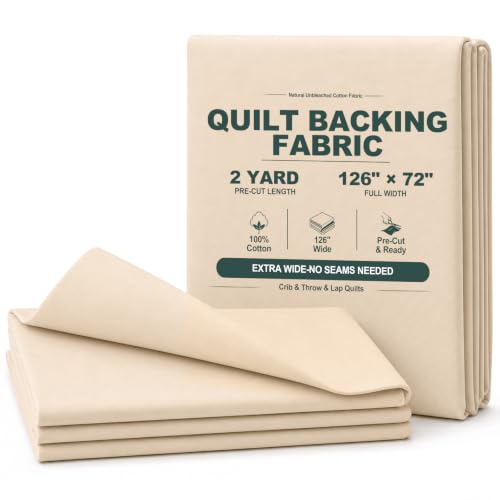
Wide backing costs more per yard, but a 60 × 80 in top fits on one piece at 2⅛ yd, with no seam to match or quilt across. Compare the two prices before you decide.
Backing yardage by quilt size
| Quilt top | Backing size (4 in extra per side) | 44 in fabric (40 in usable) | 108 in wide backing |
|---|---|---|---|
| Crib / baby 36 × 52 in | 44 × 60 in | 2⅝ yd (2 panels) | 1⅜ yd (1 panel) |
| Throw / lap 50 × 65 in | 58 × 73 in | 3⅜ yd (2 panels) | 1¾ yd (1 panel) |
| Twin 68 × 86 in | 76 × 94 in | 5⅜ yd (2 panels) | 2¼ yd (1 panel) |
| Full 84 × 90 in | 92 × 98 in | 7⅞ yd (3 panels) | 2¾ yd (1 panel) |
| Queen 90 × 95 in | 98 × 103 in | 8⅜ yd (3 panels) | 2⅞ yd (1 panel) |
| King 108 × 95 in | 116 × 103 in | 8¾ yd (3 panels) | 3⅜ yd (1 panel) |
Computed with the same rules as the calculator, the cheaper seam direction, ⅛ yd cushion. Quilt sizes follow the Missouri Star chart.