Overview
Sewing machines and sergers are often confused by new sewists, partly because both machines stitch fabric and both sit on a sewing table. In practice, they do different jobs, and most sewists eventually use both rather than choosing one over the other permanently.
This guide explains what each machine actually does, the practical differences between them, and how to think about whether a serger belongs on your shopping list as a beginner or as a later addition once you have more specific projects in mind.
What a sewing machine does
A standard sewing machine uses a single needle and a bobbin to create a lock stitch, where top and bobbin threads interlock inside the fabric layers. This stitch is versatile enough for construction seams, topstitching, buttonholes, zippers, and most general sewing tasks.
Sewing machines are the right tool for almost everything involved in actually constructing a garment or project -- joining pieces, inserting closures like zippers and buttons, and topstitching visible details. A sewing machine can sew both wovens and knits, though knit fabric may need specific stitches or needle types to handle stretch well. See our needle guide for matching needle type to fabric.
What a serger does
A serger (also called an overlock machine) uses multiple threads -- commonly three or four -- along with a built-in cutting blade to trim the fabric edge and wrap thread around it in the same pass. This produces the clean, professional-looking finished edge you often see inside ready-to-wear clothing seams.
Sergers excel at finishing raw edges so they don't fray, and at sewing stretchy knit seams with built-in give, since the overlock stitch itself has some stretch. However, a serger generally isn't used for topstitching, buttonholes, zippers, or most closures -- those tasks still go through a standard sewing machine.
Because a serger trims fabric as it sews, mistakes are less forgiving to unpick than a regular seam, since the trimmed seam allowance can't easily be restored. This is one reason many sewists prefer to gain some sewing-machine confidence before adding a serger to their workflow.
Key differences at a glance
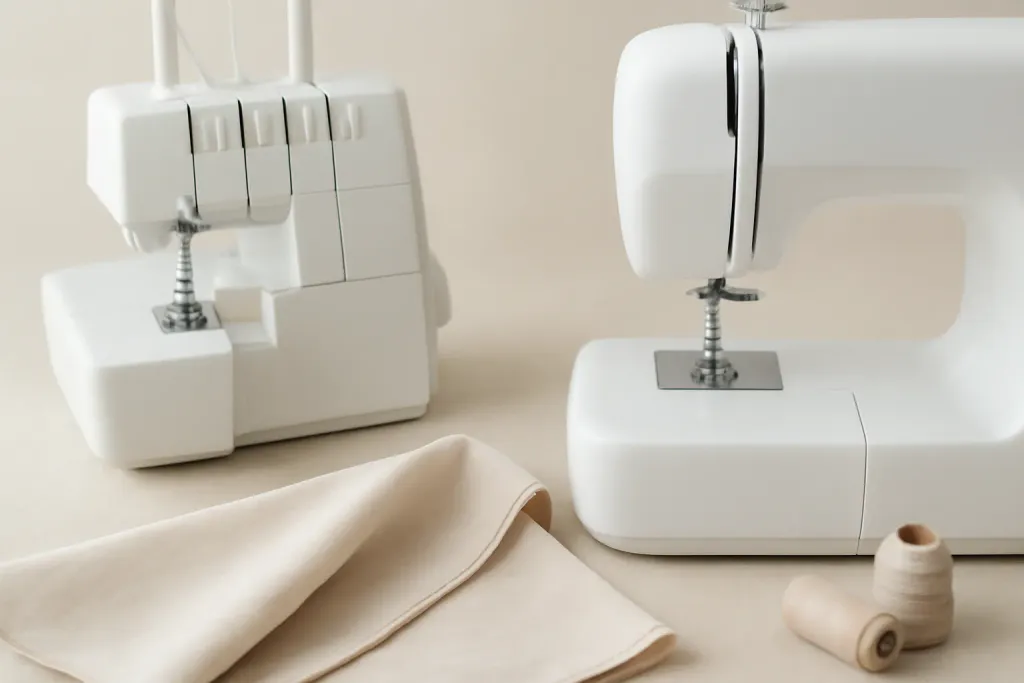
A sewing machine typically uses one or two threads and doesn't trim fabric as it sews, which makes it more forgiving for beginners and more versatile for different stitch types and closures. A serger uses three to five threads, includes a built-in cutting blade, and specializes in edge finishing and stretch-fabric seams rather than general-purpose construction.
Threading a serger is generally more involved than threading a sewing machine, simply because there are more thread paths to manage across multiple cones. This isn't a reason to avoid a serger, but it's worth knowing before assuming a serger will be as quick to set up as a sewing machine on your first attempt.
Price and size also tend to differ, with entry-level sergers often priced similarly to or above entry-level sewing machines, and requiring their own dedicated table space alongside rather than instead of a sewing machine.
Does a beginner need both?
Most beginners don't need a serger on day one. A sewing machine alone can complete an enormous range of projects using a zigzag stitch or a machine's built-in overcast stitch to finish raw edges reasonably well, even without a true overlock finish.
A serger becomes more useful once you're sewing knit garments regularly, want faster and cleaner edge-finishing on wovens, or you're producing enough finished projects that the time savings on edge finishing start to matter. If you're still building core sewing-machine skills, it's reasonable to treat a serger as a later addition rather than a starting purchase.
If budget allows for both from the start and you already know you'll be sewing a lot of knit fabric, buying both isn't unreasonable -- just don't feel that a serger is required to start sewing successfully.
It can help to track which projects you find yourself avoiding or dreading because of edge finishing, over your first several months of sewing. If a pattern of knit-heavy or edge-finishing-heavy projects emerges, that's a reasonable, concrete signal that a serger would solve a real problem you're actually running into, rather than a hypothetical one.
It's also worth borrowing time on a friend's serger, or trying one at a class or shared workspace if the opportunity comes up, before buying your own. Getting a feel for the threading and workflow firsthand can make the decision easier than reading about it alone.
There's no fixed timeline for when this decision should happen -- some sewists reach it within a few months, others sew wovens exclusively for years without ever feeling the need for a serger. Let your own project history guide the timing rather than a general rule of thumb.
Browse our recommended products
Our featured picks refresh periodically. While we update them, our editorial guides can help you find the right pick.
See our guidesWhat to buy first
If you're choosing one machine to start with, a sewing machine is almost always the better first purchase, since it covers general construction, closures, and topstitching that a serger cannot do on its own. See our sewing machine buying guide for how to evaluate a first machine.
Once you're comfortable with your sewing machine and have a specific reason to add a serger -- frequent knit sewing, faster edge finishing, or a specific technique you keep running into -- that's a reasonable time to start comparing serger options with the same disclosed-criteria approach as any other machine purchase.
What about a coverstitch machine?
A coverstitch machine is a third, less common category worth knowing about, since it's sometimes confused with a serger. It creates the parallel rows of stitching you see on the hems of most ready-to-wear knit t-shirts, which stretch with the fabric instead of popping like a regular straight stitch would.
Some higher-end sergers include a coverstitch function alongside their overlock stitches, while others are dedicated single-purpose coverstitch machines. Neither a coverstitch machine nor a serger typically replaces the other, and both are generally considered additions for sewists who are already comfortable with a standard sewing machine.
For most beginners, a coverstitch machine is even further down the list than a serger -- it solves a specific hemming problem on knit garments that usually isn't the first thing a new sewist runs into.
Using a sewing machine and serger together
Sewists who own both machines typically move a project between them during construction, rather than using one machine for an entire project start to finish. A common workflow is sewing main construction seams on a regular machine, then finishing raw edges on the serger, or the reverse for certain knit garments where the serger handles the main seams.
Having both machines set up and threaded at the same time, each with commonly used thread colors already loaded, can save time if you sew often enough to justify the dedicated space. For occasional sewists, re-threading one machine as needed between steps is a perfectly reasonable alternative to owning two machines outright.
If desk or table space is limited, consider which machine you'll reach for more often before assuming you need both set up permanently. Many sewists keep their sewing machine out full-time and bring the serger out only for projects that specifically call for it, storing it in its case between uses to save space without adding much extra setup time.
Final thoughts
A sewing machine and a serger aren't competing options -- they're complementary tools built for different parts of the sewing process. Start with a sewing machine, build core skills, and add a serger later if your projects genuinely call for one.
See our sewing machines hub for more buying guidance, and our using a sewing machine for beginners guide if you're just getting started.